

This reporting was supported by the ARLnow Press Club. Join to support in-depth local journalism — and get an exclusive early morning email with a preview of that day’s planned news coverage.
When plans were announced for Arlington’s bicentennial celebration in 2001, one question emerged among county residents: It was the bicentennial of what, exactly?
The year-long series of events marked the 200th anniversary of the incorporation of modern-day Arlington into D.C. in 1801. To create the federal district, a new “Federal County of Alexandria” consisting of modern-day Arlington and Alexandria was carved out of Fairfax County.
The federal county would last less than a half-century, when the areas were “retroceded” back to Virginia, but “Alexandria County” wouldn’t be renamed “Arlington” until 1920.
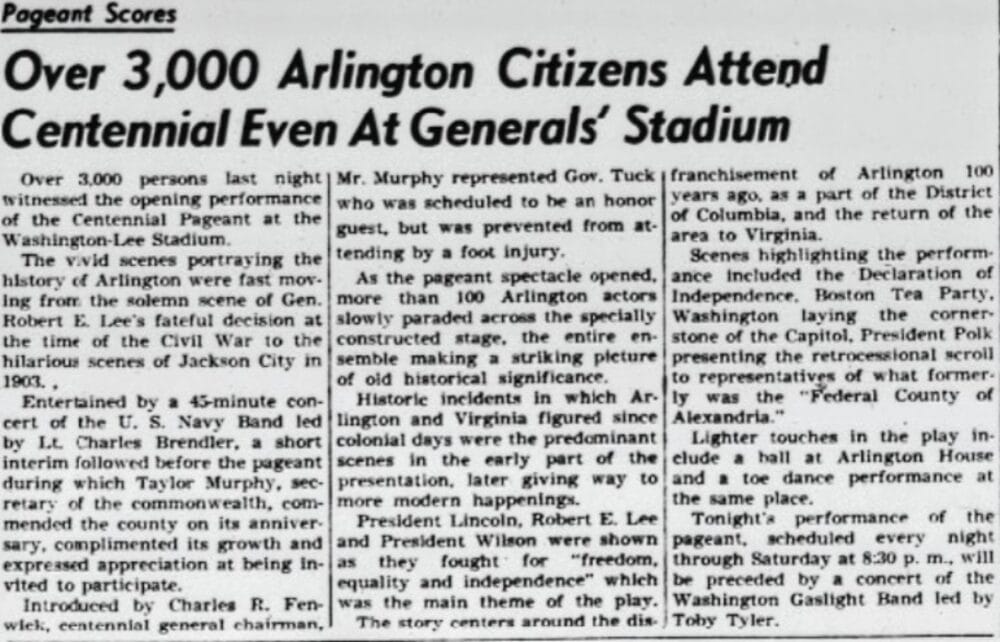
To mark 100 years since the county’s return to Virginia, Arlington leaders in September 1946 hosted a centennial pageant that drew 3,000 to the stadium at what was then Washington-Lee High School.
Despite just 54 years having elapsed since that centennial celebration, county leaders in 2000 determined that they should treat 2001 as the county’s 200th anniversary.
And thus the Arlington Bicentennial Task Force was born. Underwritten in part by the county government as well as through grants and contributions, it oversaw events big and small throughout the year.
While the agenda was by necessity curtailed after the 9/11 terrorist attacks and their impact on Arlington, the bicentennial experience was, for the most part, deemed a success.
Yet perhaps surprisingly, considering events took place just a quarter-century ago, the historical record is a little thin.
The commission operated a website at www.arlingtonhistory.org, but sometime after the celebration it went offline. Today, it redirects to the Arlington Historical Society’s website. Some information is available at the Charlie Clark Center for Local History, but it too paints a somewhat incomplete picture.
But using available resources, and drawing from the memories of some of the participants, the efforts from a quarter-century ago come into clearer view.
A six-month head start
County Board members created the 17-member Arlington Bicentennial Task Force in June 2000, tapping civic leaders Margaret Lampe and Talmadge Williams as chair and vice chair, respectively.
“People are very, very enthusiastic,” Lampe said after the group held its first meeting that July.
Membership included representatives from a wide variety of groups, including the Arlington County Civic Federation, Arlington Chamber of Commerce, Historical Affairs and Landmark Review Board, Fort Myer and Arlington Historical Society.
Barbara Favola, who chaired the County Board in 2000, said the panel represented “the rich mosaic” of present-day Arlington.
The panel was tasked with sending a report to the County Board in November 2000, outlining its plans for the coming year and how everything would be funded.
“We are hoping that this produces a lot of enthusiasm across the county as word spreads,” said Lampe, a former School Board member and, with her husband Hank Lampe, one of Arlington’s political “power couples” of the period.
The panel also was tasked with coordinating with its counterparts in D.C. and Alexandria, which also were planning celebrations marking establishment of the 100-square-mile federal enclave.
In June 2021, the County Board approved an appropriation of $50,000 to support work of the task force. It was on top of $100,000 in private contributions and approximately $100,000 in in-kind donations the group had raised, according to Sun Gazette coverage.
Getting into the ‘spirit’
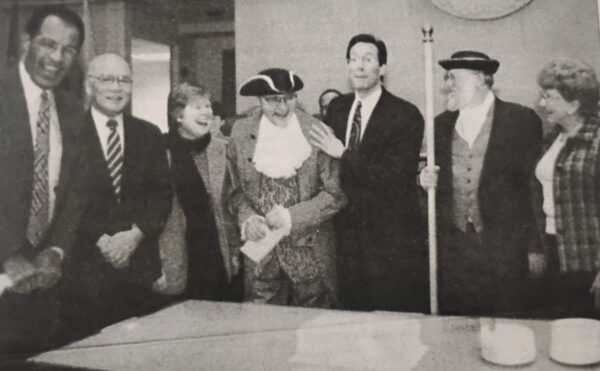
At the Jan. 1, 2001, County Board organizational meeting, former Board member and amateur historian Albert Eisenberg arrived in the guise of the “Spirit of Arlington” — a colonial man who had seen all of the county’s 200 years of history.
Among his comments:
“I remember an agrarian community of scattered farms; now I see a modern metropolis of commercial centers and beautiful history. I have heard the drums of the Civil War and seen a nation reunited. From cowpaths and dirt roads, we have become a transportation center. I have watched our one-room schoolhouses give way to an educational system of national renown and a college and university of great quality.”
“From the population I knew, of two colors and one language, today we display all colors and hear all the sounds of the world. I have marched to the call of civil rights and seen us move beyond Jim Crow South to a place of caring, openness and respect for diversity.”
As for the bicentennial celebration itself, the Spirit of Arlington predicted “a wide variety of activities and celebrations [that will] instill in our community a sense of place, of who we are, and what Arlington is about. And most importantly, we will have fun.”
Serving as County Board chair in 2001 was Jay Fisette. In a recent interview with ARLnow, he acknowledged that his recollections of the bicentennial celebration “are sadly vague” given the passage of time and the impacts of 9/11 that required a massive county response in the final months of 2001.
But he did have some recollections.
“I know my Jan. 1 statement as chair was titled ‘Connecting Our Past to Our Future: The Bicentennial to E-Government.’ I remember the mural painted in the county office building stairwell. I remember the ceremony when we buried some mementos from 2001 for a future generation to unearth.”
In that recent interview, Fisette praised the leadership of Lampe during the bicentennial period.
“She, with Talmadge, was a powerhouse,” he said.
A March kickoff
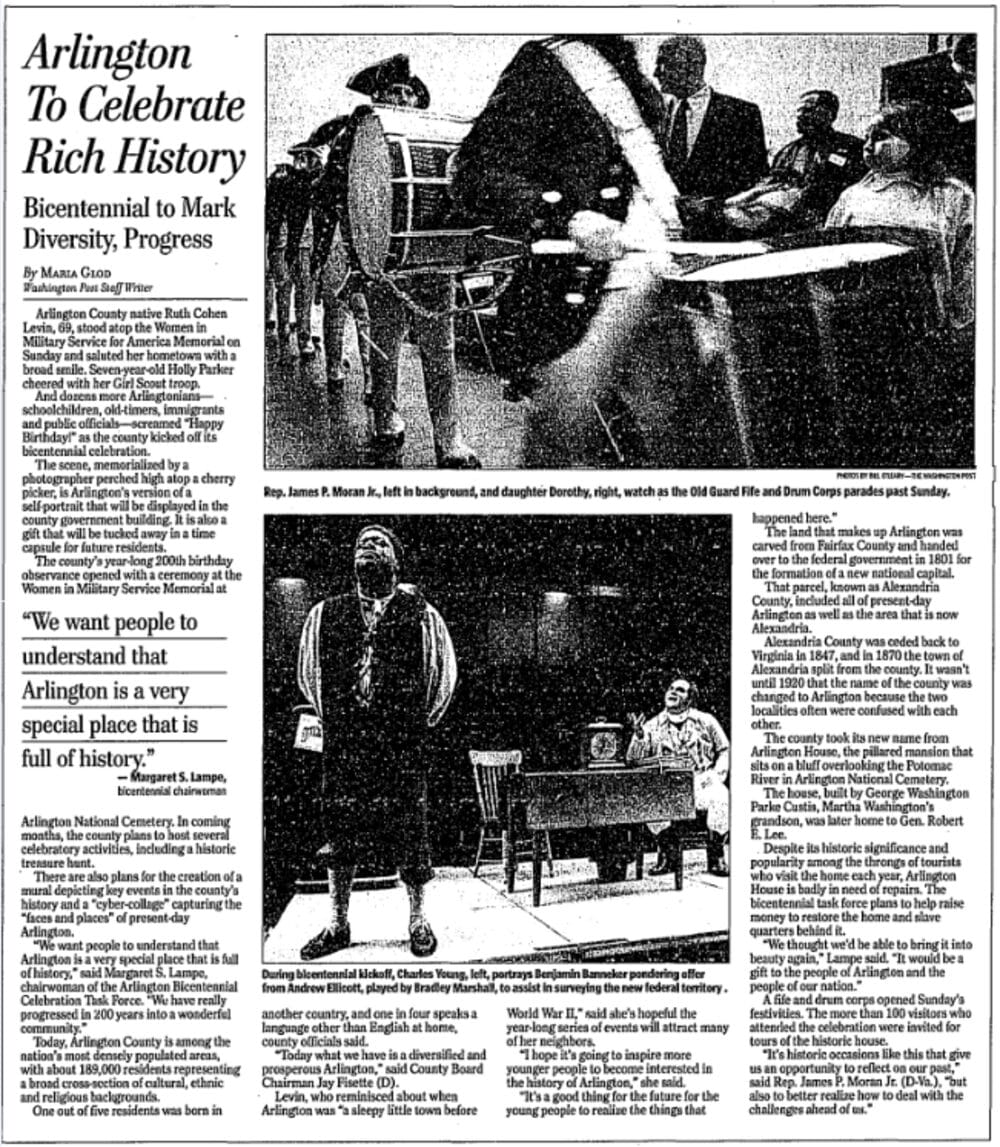
The bicentennial kicked off on wet and windy Sunday in March 2001 with an event at the Women in Military Service to America Memorial (now Military Women’s Memorial) adjacent to Arlington National Cemetery.
“Arlington has had a colorful and illustrious past, and has a promising future,” said then-U.S. Rep. Jim Moran (D-8), one of the speakers at the standing-room-only event.
The kickoff also included a presentation of “The Great Beginning,” a play looking back at the placement of stones that marked the boundary of the District of Columbia. Charles Young portrayed Benjamin Banneker and Bradley Marshall Andrew Ellicott in the performance.
Among those attending the kickoff was 69-year-old community leader Ruth Cohen Levin, an Arlington native who had watched the county grow beyond its once-rural roots.
Arlington was “a sleepy little town before World War II,” Levin told Washington Post reporter Maria Glob, adding that she hoped the bicentennial celebration would “inspire more younger people to become interested in the history of Arlington.”
Historical ‘treasure hunt’
One of the features of the bicentennial celebration was an historical treasure hunt.
Despite the name, it wasn’t a chance for individuals to scurry across the county finding items — instead, it was a 200-question quiz about the county’s history.
Here is a sampling of the questions, with answers further below:
- What English explorer led his men up to Potomac River in 1608, reaching the area now known as Arlington?
- A turnpike was constructed in 1808 to connect Long Bridge to Little River Turnpike. What was its name?
- What major highway, constructed in the 1930s, stretches from Ocean City, Md., to Sacramento, Calif., passing through Arlington on its way?
- In what years was county land lost to Alexandria in annexation battles?
- Who was the first president of the Arlington Historical Society in 1956?
- Besides John F. Kennedy, what president is buried at Arlington National Cemetery?
- During his lifetime, how many acres of present-day Arlington did George Washington own?
- What was the name of the Potomac River island once owned by the Mason family?
- What two golf courses are located in Arlington County?
- In what year did Metrorail service begin in Arlington?
- At what fort in the Civil War were the 107th United States Colored Troops located?
- What was the name of the riderless horse from Fort Myer that took part in the funeral procession of John F. Kennedy?
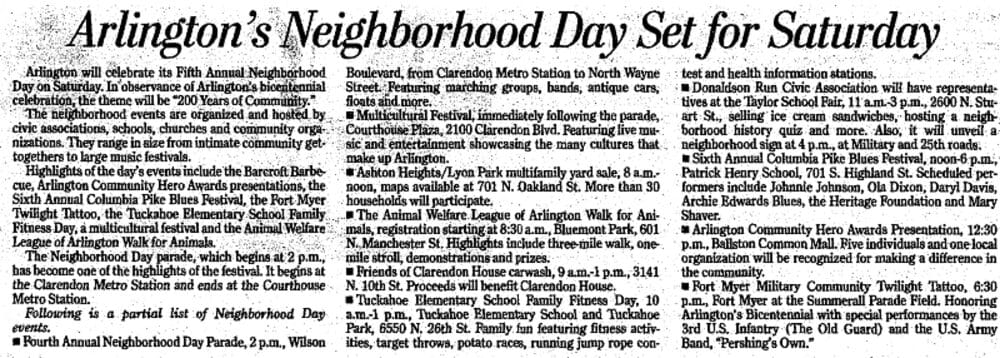
Neighborhood Day
Arlington in May 2001 marked its fifth annual Neighborhood Day celebration, with community events big and small largely sponsored by civic organizations and community groups.
The bicentennial was the theme of the 2001 event, with sponsoring groups asked to tie their events into the broader commemoration. It also was the theme of the Neighborhood Parade that took place in the early years of that annual celebration.
Community ‘tableau’
Thomas Jefferson Community Theatre in September 2001 played host to a “tableau” marking the county’s 200th anniversary.
Dozens of adults and youth presented 10 scenes of Arlington’s 200 years of history, with evening presentations Sept. 21-22 and a Saturday matinee on Sept. 23.
Performances went on despite the 9/11 terrorist attacks of just two weeks before.
“It presents an opportunity for all of us to take some time to gain a sense of our beginnings as a county and our unique place in American history,” Fisette said in announcing performances would take place as scheduled.
Park dedication
As part of bicentennial events, a dedication ceremony was held Oct. 14, 2001, for Andrew Ellicott Park at 2824 N. Arizona Street.
The 0.25-acre park is home to one of the original District of Columbia boundary stones, and was named after the man who surveyed the District’s boundaries.
Museum honoring Black heritage
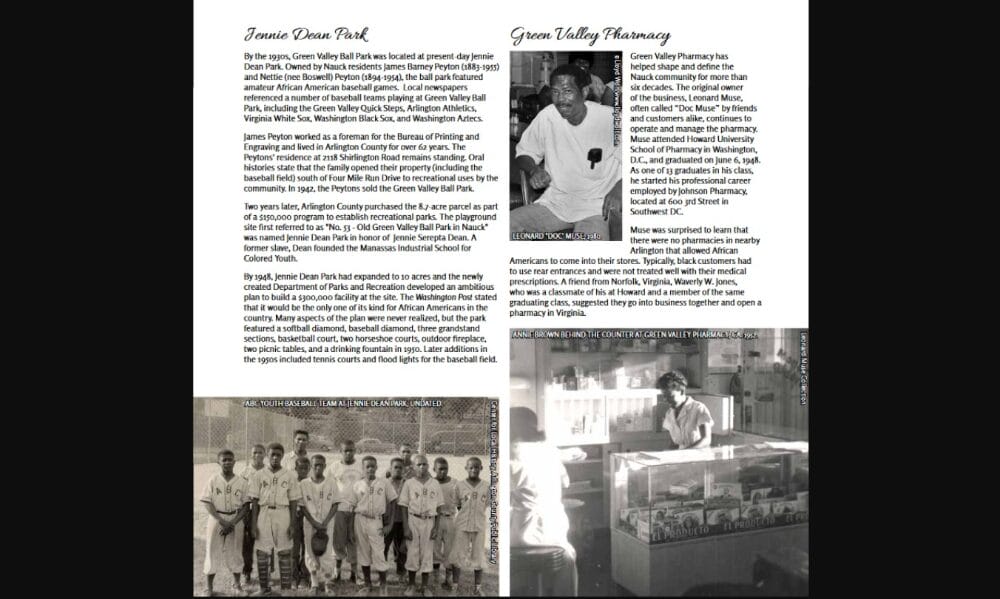
One of the goals of the bicentennial celebration was to find a permanent home for a museum to mark Black history in the county.
Williams said too much of Arlington’s history remained hidden from view, especially when it pertains to African Americans.
“They have a history that needs to be told, or else it will be as if those people never lived,” he said in a Sun Weekly article in 2000.
Rich Doud, then president of the Arlington Chamber of Commerce, also was involved in the planning process.
“Clearly we have a unique and strong African American heritage in the community,” Doud said.
Up to that point, efforts to turn the concept into reality had hit roadblocks, Doud said.
“We’ve been down any number of paths without success,” he said.
Though not directly due to efforts of the bicentennial task force, the community did end up as the home to the Black Heritage Museum of Arlington. First existing as an online “museum without walls,” it now occupies space on Columbia Pike.
The task force worked with the county government to publish a guide to African American history in 2001. It was expanded and updated in 2016.
Time capsule
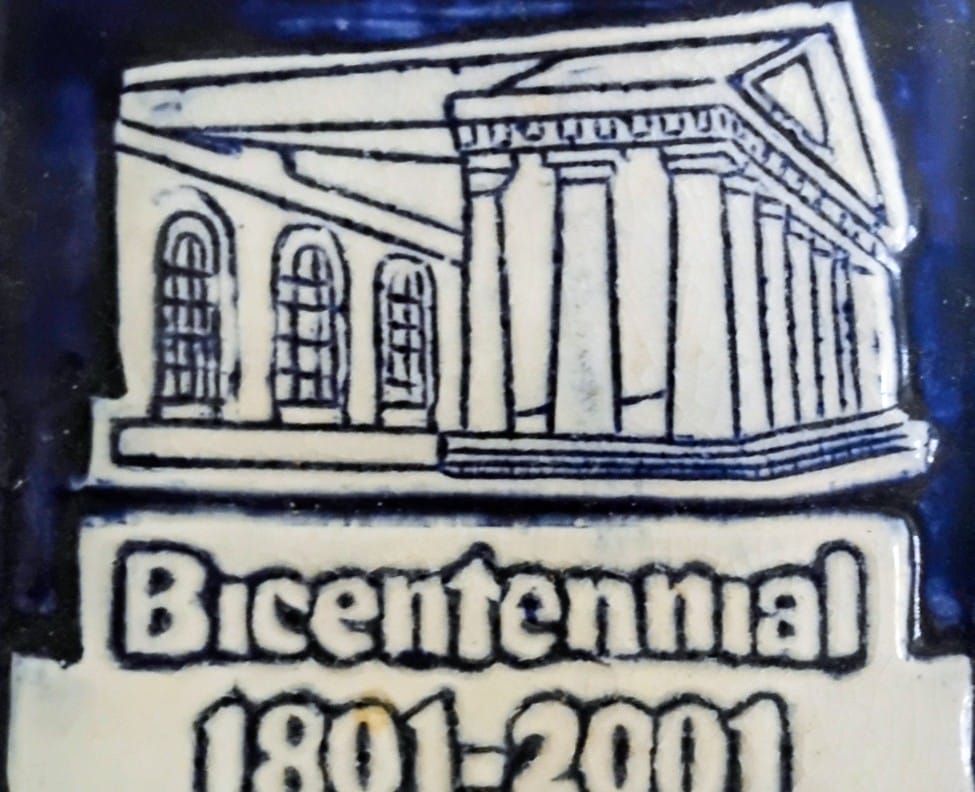
Among the events leading to the conclusion of the bicentennial celebration was dedication of a time capsule placed in the county government’s headquarters at 2100 Clarendon Blvd.
Task force chair Lampe led the events, which included participation from numerous schoolchildren.
Given the passage of time and several renovation projects on the building since 2001, it is an open question whether the capsule remains in its original location — or even where that original location might be. If it’s still there, it awaits a reopening ceremony sometime in 2051.

Arlington House upgrade
One of the major initiatives of the bicentennial celebration was an effort to support the renovation of Arlington House, the Custis-Lee Mansion and, somewhat controversially these days, the nation’s official memorial to Robert E. Lee.
“The house really is in deplorable condition. It needs to be helped significantly,” Lampe told the Arlington Journal in December 2000.
Even before the bicentennial year of 2001 began, Sens. John Warner and Charles Robb and Reps. Jim Moran and Frank Wolf secured funding to begin restoration efforts as well as support renovation of two slave quarters on the property.
State funding also was secured to help the project.
At the time, the National Park Service estimated the cost of bringing the mansion house up to “minimal standards” would be $1.6 million. A more comprehensive rehabilitation project across the property could cost up to $6 million, it was estimated.
The effort to secure funding for a complete rehabilitation of the mansion house and grounds did not fully materialize in the immediate aftermath of the bicentennial celebration. But it was not forgotten.
A $12.4 million donation from philanthropist David Rubenstein allowed for full renovation to take place, starting in 2018. In 2021, the project was completed and the National Park Service property was reopened.
At its height, Arlington House was surrounded by 1,100 acres of grounds. The property, owned by Lee through his marriage to Mary Anna Custis (a great-granddaughter of Martha Washington), was seized by the federal government at the outset of the Civil War.
Its grounds then formed the nucleus of what would become Arlington National Cemetery. After a lengthy court battle, family of the then-deceased Robert E. and Mary Anna Lee in the 1880s received a settlement of $150,000 — equivalent to more than $16 million today — from the federal government related to seizure of the property.
Bicentennial banquet
The Arlington Historical Society hosted a “bicentennial banquet” in April 2001 at Army-Navy Country Club.
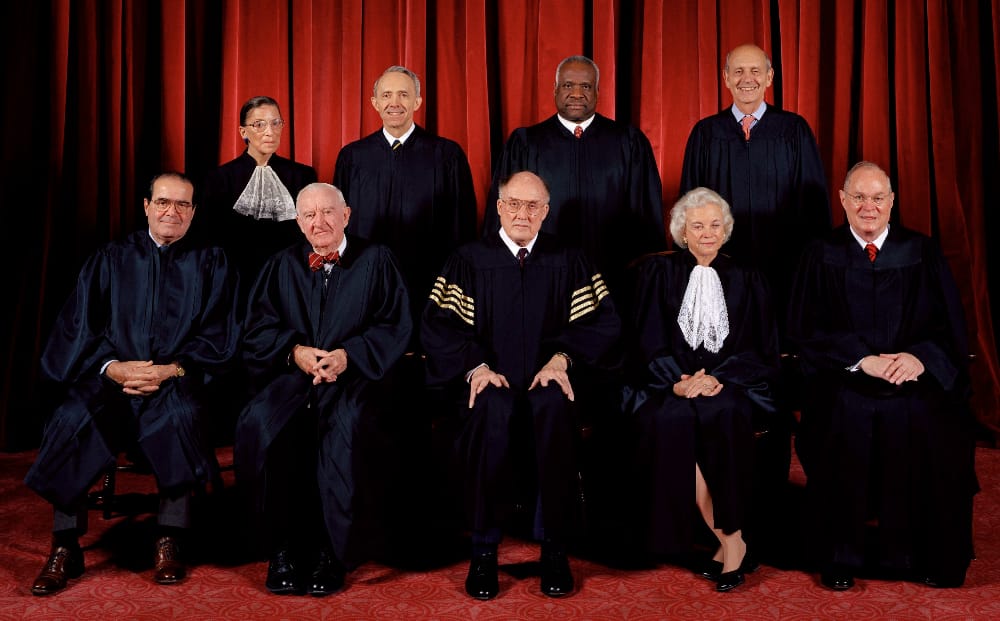
The guest speaker was Chief Justice William Rehnquist, who by then had been an Arlington resident for 17 years.
He called being asked to provide remarks about the history of Arlington “a great pleasure,” but like some others, was not totally sold on the idea that 2001 marked the “bicentennial” of the county.
Rehnquist suggested that it might be best if Arlington marked its beginning as starting in 1920, when the General Assembly gave its present name to the community.
With that caveat out of the way, the chief justice plunged into a retrospective of two centuries of local history. Among his topics was the battle between the Lee family and federal government over ownership of Arlington House plantation and grounds. According to Rehnquist:
“Congress enacted a law in 1863 which required owners of land occupied by federal troops to pay taxes to federal tax collectors. A tax of $92.07 was assessed against Arlington House, but Mrs. Lee, who was too frail to appear in person, sent a relative to pay the tax. The Tax Commissioners in Alexandria refused to accept the payment, saying that the owner must appear in person to pay the tax, and the estate was sold for taxes. It was bought in 1864 by the federal government for $26,800.”
“There was no doubt that the tax commissioners were wrong when they refused to accept Mrs. Lee’s tender of the money owed for taxes by a relative. The law imposed no such requirement,” Rehnquist said.
As a result, the U.S. Supreme Court voted 5-4 in 1882 to compensate the family for its losses.
While there was a sense of fairness in the verdict, Rehnquist acknowledged, it proved problematic for judges in subsequent cases, as it muddled past rulings over the concept of sovereign immunity — that the federal government couldn’t be sued.
Clarification on that topic wouldn’t come until decades later, when courts became more lenient in allowing lawsuits against the federal government to take place.
Glebe house purchase?
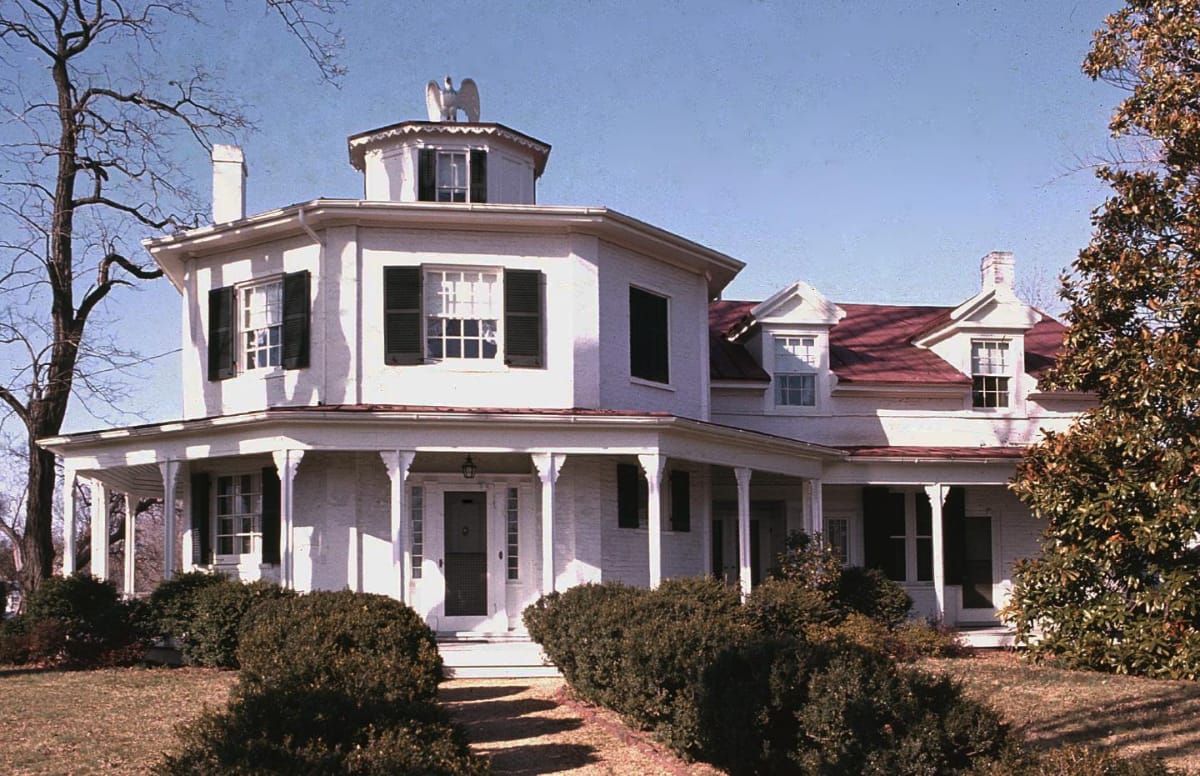
One of the goals of the task force during the bicentennial year was to purchase the Glebe House, one of the most historic homes in Arlington.
“The National Genealogical Society is selling the property, and we feel this would be a fitting place to house all our historical records and allow the public to access them more easily than in the past,” the task force said.
The property began life as a 500-acre farm for the rector of the Church of England’s Fairfax parish.
The original home was constructed in 1775 but burned in 1808. Its replacement was constructed in 1820, with the signature octagonal-shaped wing constructed in the 1850s.
The task force fell short in this goal, with the property being sold to a family for just over $1 million in 2004. Located on 17th Street N., it remains in private hands, but the Northern Virginia Conservation Trust holds a conservation easement.
This year, the trust joined with the Arlington County Historical Society to host the first annual “Glebe House Day,” with the grounds open to the public for a three-hour period.
Back to the quiz
More than 150 local residents took a shot at the 200-question Treasure Hunt quiz detailed above, with Harlan Messinger edging out the competition.
Messinger received a final score of 197.5 correct entries, followed closely behind by Bernie Berne (197.33) and Paul Raca (197).
Ten competitors got at least 193 of the 200 questions correct, while more than 40 were correct on at least 188.
“The amount of work that people put in was simply amazing,” said Gene Karp, a member of the bicentennial task force who oversaw the competition.
One of the questions in the competition ended up being thrown out for a factual inaccuracy. It had asked what brother-and-sister duo born in Arlington had won Academy Awards.
Siblings and Washington-Lee High School graduates Warren Beatty and Shirley MacLaine are each Oscar-winners, but it turned out they weren’t born in the county.
For winning the competition, Messinger received two round-trip tickets anywhere in the domestic United States served by US Airways. Winning the same prize was Julie Pearce, who was selected in a drawing among all entrants who answered 25 or more questions correctly.
As for the dozen questions above, here are the answers:
- What English explorer led his men up to Potomac River in 1608, reaching the area now known as Arlington? Capt. John Smith
- A turnpike was constructed in 1808 to connect Long Bridge to Little River Turnpike. What was its name? Columbia Pike
- What major highway, constructed in the 1930s, stretches from Ocean City, Md., to Sacramento, Calif., passing through Arlington on its way? U.S. Route 50
- In what years was county land lost to Alexandria in annexation battles? 1915 and 1929
- Who was the first president of the Arlington Historical Society in 1956? C. Harrison Mann, Jr.
- Besides John F. Kennedy, what president is buried at Arlington National Cemetery? William Howard Taft
- During his lifetime, how many acres of present-day Arlington did George Washington own? Between 1,100 and 1,225
- What was the name of the Potomac River island once owned by the Mason family? It has been called Analostan Island, Mason’s Island, Barbadoes and My Lords Island, and currently is known as Theodore Roosevelt Island
- What two golf courses are located in Arlington County? Army-Navy Country Club and Washington Golf & Country Club
- In what year did Metrorail service begin in Arlington? 1977
- At what fort in the Civil War were the 107th United States Colored Troops located? Fort Corcoran
- What was the name of the riderless horse from Fort Myer that took part in the funeral procession of John F. Kennedy? Black Jack
Editor’s note: This piece’s author was a member of the Arlington Bicentennial Task Force in 2000-01. As with Fisette, his memories were “sadly vague” until refreshed by research. Thanks as always to the Charlie Clark Center for Local History and the University of Virginia’s “Virginia Chronicle” news archive for support of that research.
